
Director’s cut: Frank Paur on the making of “X-Men: Evolution”

("X-Men: Evolution" series poster/https://www.themoviedb.org/tv/668-x-men-evolution/images/posters)
By Anna Vogt
Frank Paur, one of the directors behind “X-Men: Evolution,” reflects on the animated series 25 years after its debut. Paur discusses the show’s origins and character development and offers a behind-the-scenes look at why it is so revered among fans.
“X-Men: Evolution,” a children's show that first aired in November 2000, stood out among many superhero series for a variety of reasons; in particular, its portrayal of mutant teenagers tackling true-to-life themes like identity, prejudice, and moral complexities made it truly unique. Its adaptation and portrayal of popular characters, like Rogue and Cyclops, proved to be a draw for fans.
Originally airing on Kids’ WB, the show received positive appraisal and even won three Daytime Emmy Awards.
But how did it all begin?
According to Paur, it all started with Boyd Kirkland.
“Boyd and I had a long history working together,” Paur said. “Boyd called me up and said that he had gotten this offer from Marvel.”
By this point, Paur had previous experience working for Marvel, including “G.I. Joe: A Real American Hero” and “X-Men: The Animated Series.”
“Boyd's a good friend, and I thought, ‘Well, it sounds interesting. Why not give it a try?” he said.
Paur explained that Marvel didn’t want the team to create a series that aligned with other related shows, like “X-Men: The Animated Series.” “X-Men: Evolution” was meant to be something entirely new.
“They wanted something to distinguish it. One of the things that we had discussions on — the fact that the original comic book started off, all the X-Men were not men, they were teenagers,” Paur explained.
The team used this original comic and adapted it into the primary plot for their animated series; however, they vastly modernized it. Paur stated that the first season of “X-Men: Evolution” was spent experimenting — partly because the original writing overemphasized adventure.
“There's always going to be an adventure thing with the X-Men, but we didn't want the adventure to dominate,” Paur said. “And so, it was trying to find that balance between the two.”
Focusing on character development, rather than just action or adventure sequences, created immersive, realistic characters that audiences loved. And according to Paur, the distinct characters' realism can be attributed, in part, to Boyd Kirkland and Craig Kyle.
“I credit a lot of that to Boyd Kirkland and to Craig Kyle. You know, they had teen daughters,” Paur said. “They used that as a source to talk with their kids about certain things, get their reactions in that, so it felt more normal within the show.”
Additionally, Paur credits Steven Gordon, producer and storyboard artist, for the longevity and success of the series:
“We had Steve Gordon on our show. Steve was essential. He was actually a trained animator. He would animate stuff out — the character designs and models. He was so thorough on them. They left no question for the animator to figure out how to do things, because it was all done for them: how the characters walked, the personality of the characters. Steve was essential in all of those things.” Paur said.
Steven Gordon’s attention to detail and talent in animation and character development were critical to the show’s success. In fact, it is partly why fans still love the series today.
“And when you look at the animation, it's not that we had a bigger budget than everybody else, it's just that we had people who knew what they were doing,” Paur said. “And when you look at the animation of X-Men Evolution and compare it with all these other superheroes, it still holds up.”
For the love of superheroes
Paur knows about superheroes and how to craft an appealing story. There are many reasons why the masses may love superheroes — the action, the adventure, the superpowers, the characters.
“As we grow up, we have a lot of these different things that we have to deal with. We have to deal with the bullies, or the parents that don't quite get you, or that nasty big brother, you know — all that kind of stuff,” Paur said.
Even as children, viewers often identify with these characters as an outlet for expression.
“Most people who like superheroes start at an early age. I think it's because of that thing where they kind of envision themselves as having these powers.” Paur explained. “With great power comes great responsibility, but it also means you don't have to take any stuff from anybody. And I think from a child's point of view, that's very important.”
A superhero's power has a purpose beyond being fantastical and imaginative:
“I think that's the big thing — I think with superheroes, it's not about just having power for the sake of power, but power used wisely to change things,” Paur said.
From comics to screens: Scott Summers
Adapting characters and translating them across different media can be difficult. Although each “X-Men: Evolution” character was adapted to fit the series, one character substantially shifted away from the original comics.
According to Paur, Scott Summers — also known as Cyclops — was the character most drastically changed from his on-page counterpart.
“In the comic book, he's the Boy Scout. He has very little personality. He's stern. He's the commanding presence,” he said. “In the comics, where he was unsure, and he was afraid of letting his powers loose, because he didn't want to hurt people, we bypass that stage of his life.”
By the time viewers are introduced to Cyclops, he has already worked through these personal struggles. This new version of Cyclops is far from unsure.
“He drives sports cars. Motorcycles. So, he's very privileged, because of Professor X and all the facilities and everything,” Paur said. “He's got a very strong personality into who he is and his place in the universe, and he's conquered a lot of that stuff that he had before.”
The creation of a more confident Scott Summers was a well-thought-out decision, rooted in one of the series' themes: Leadership.
“We tried to make him likable,” Paur said. “He was never much liked in the comics or the animation, because he's always, like I said, he's just very stiff, and we wanted him to be somebody that you would actually enjoy talking to, because he is a leader.”
Once they established this, the team had to ask targeted questions to better understand the character.
“How would somebody under his circumstances react to all the world around him, and the responsibilities that have been given to him?” Paur explained. “And so, we just kind of took it from there.”

(Scott Summers in "X-Men: Evolution"/https://x-menevolution.fandom.com/wiki/Cyclops)
The reimagining of Kitty Pryde
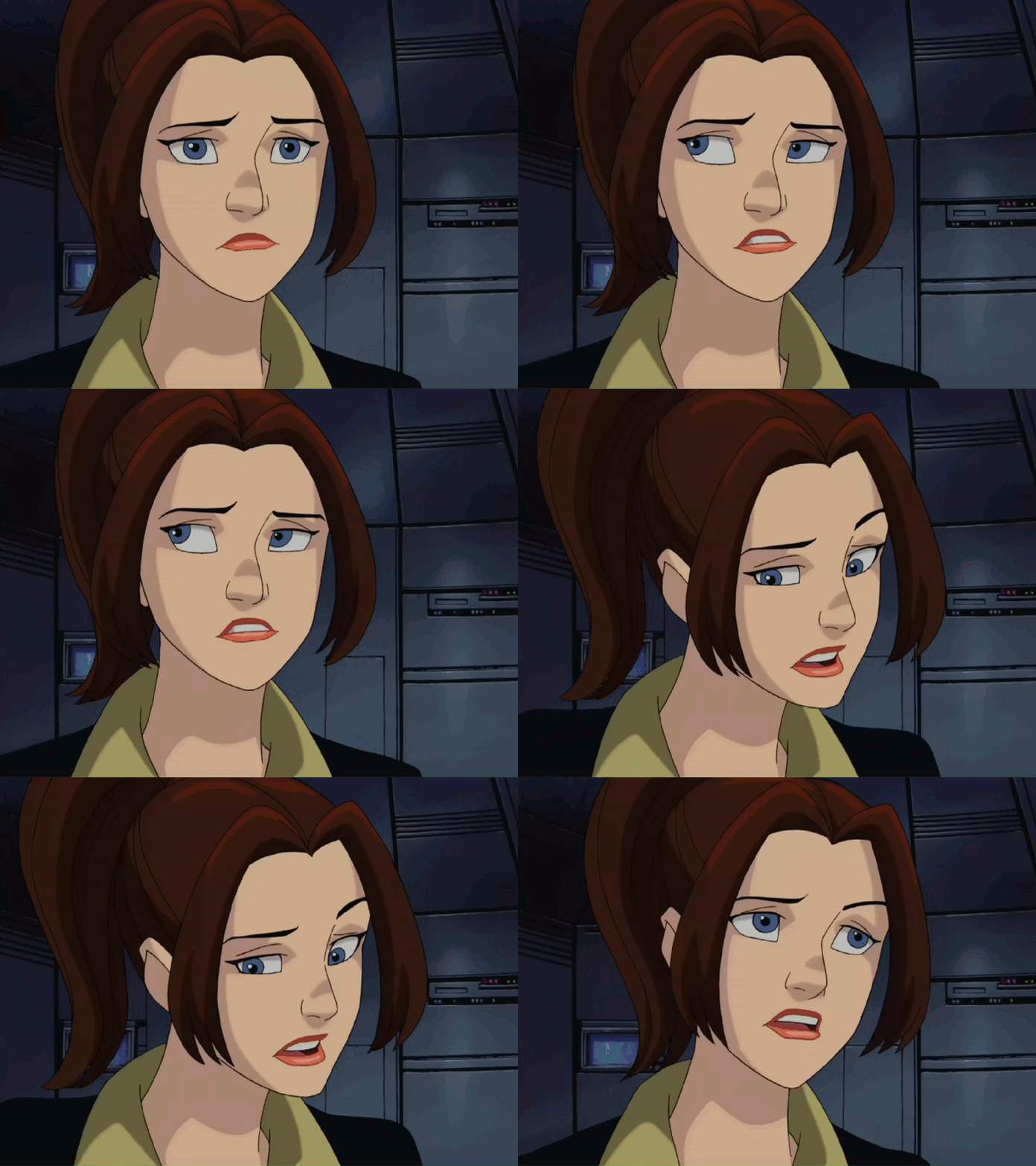
Another key character in the series, Kitty Pryde, also underwent changes for her debut in “X-Men: Evolution”. However, according to Paur, these changes weren’t initially embraced by fans.
“X-Men fans did not like Kitty Pryde at first, because they pictured her as being different — and we pictured her as a valley girl,” Paur explained. “That's who everybody was familiar with…we all live in California.”
And a fun fact: Much of the creative team's decision-making regarding characters and worldbuilding happened in an unsuspecting location — a restaurant.
“We would have lunch meetings. There's this wonderful Chinese restaurant across the street from the studio we used to go to all the time. We would just talk about stuff — what we wanted this world to be,” Paur said.
Like changes made with Scott Summer, the decision to make these changes came from a place of worldbuilding and plot development.
“So, the personality is just a little bit different. She's a very smart girl. She's very likable, but she's also very naive about a lot of things. And because of that, she was the perfect foil,” Paur said.
A foil character serves the purpose of exposing or highlighting specific characteristics of the main character. In the case of Kitty Pryde, she serves as a foil and as a character lens.
“She's basically the viewer's eyes and ears, and so you're experiencing a lot of this through her,” he said. “I think in the very first episode of X-Men, she's living with her parents, and she has this weird dream about flying through the sky and being able to move through things and such, and we find out later on that she was actually doing it.”
Paur explained that after Kitty Pryde’s conflict is laid bare, other characters, like Scott Summers, are introduced to the viewers—one example of how she is used as a character lens throughout the television show.
And Paur recalls one specific episode in “X-Men: Evolution” that showcases Pryde’s character.
“'Grim Reminder,' Season 1. That's the Wolverine origin story — having to go against Wolverine, who has been taken over — his mind has been taken over. And he's hunting her,” Paur said. “She has to deal with it. There's a lot of humor and a lot of danger. But it also encapsulated who she was heroically, having to deal with this monster that's after her. It was one of the shows that did a great job highlighting her — who she really was.”
Speaking of Wolverine and his origin story, his iconic character underwent some changes.
(Kitty Pryde in "X-Men: Evolution"/https://ar.inspiredpencil.com/pictures-2023/x-men-evolution-kitty)
Wolverine: No more rivalry
While Scott Summers and Kitty Pryde underwent core character alterations, Wolverine is slightly different, as he is an adult in the series.
“One of the things we did not want to do with Wolverine is make a love triangle between Jean Grey, Scott Summers, and Wolverine, because that would have been creepy,” Paur said. “We couldn't make him a teenage character. He's an adult. He’s been an adult for over 100 years.”
Keeping Wolverine an adult creates opportunities for character growth. The dynamic between Wolverine and the teen mutant is a core driver of the series.
“He has all of this history and all of these life events. And so, he's now in a position where he has to be a teacher and a mentor to this new generation of mutants,” Paur said. “And he fits that perfectly. He's reluctant, but he does it because he knows he can make life better for them by teaching them what he's already experienced and gone through.”
Additionally, Paur explained that this dynamic erased the comic-related love triangle among Jean, Cyclops, and Wolverine — another crucial detail that shaped the series.
“When we freed him from that, he became a different character,” Paur said. “You don't want to just repeat what everybody else is continually doing throughout the years. And so, it freed the writers up to go into different directions with them, and to have him still remain Wolverine that we all know and love.”

Why Rogue didn’t fly

(Rogue in "X-Men: Evolution/"X-Men: Evolution" Rogue Recruit (TV Episode 2000) - IMDb)
“X-Men: Evolution” features another standoffish character besides Wolverine. Rogue is an incredibly popular character, and her character design for the show shifted massively. Her trademark curls were gone, replaced with a shorter, cropped cut and a goth-inspired wardrobe.
Fans of the X-Men comics may have noticed one crucial change in the series: Rogue didn’t naturally have her power of flight. According to Paur, Season 2, Episode 9, “On Angel’s Wings,” not only debuts Warren Worthington, but it also showcases Rogue in flight.
“One of the biggest changes we did in Evolution is that we did not give Rogue the Supergirl powers or Captain Marvel's powers. She couldn't fly. She had to touch somebody and absorb their powers,” Paur said.
But that isn’t the only decision that sets “X-Men: Evolution’s” Rogue apart from her comic counterpart.
Another major departure was the absence of Rogue’s comic‑book romance with Remy LeBeau, better known as Gambit.
Like Wolverine, Gambit is an adult in the series, making romance between the two a major no-no. This is a unique decision, as historically, comics have portrayed the two as a couple. Instead, “X-Men: Evolution” set its sights on a new dynamic.
“Rogue and Scott have similar beginnings in that Scott has all these powers that could inflict great harm to people, and for the longest time, he was terrified of what he could do to people, and he didn't want to meet with people until Xavier found him and brought him out of that shell, that protective shell that he was built around it,” Paur said. “And Rogue is pretty much the same way, where she has these powers that if she touches you, she can kill you just by touching you.”
Paur explained the goth look represents Rogue’s conflict and struggles.
“We incorporated that into making her a goth. We didn't want to do the Southern Belle, honey thing,” Paur said. “It didn't fit her personality for what she was going through — maybe later on it would.”
Moreover, “On Angel’s Wings” opens up the possibility that Rogue is attracted to Scott Summers:
“She feels connected to him. They have that thing where Scott's talking about the reality of “could there actually be angels” and stuff like that, and they're having this heart-to-heart talk at this little café,” Paur said. “You know what? The fans loved it.”
Paur expressed that he enjoyed working on this episode.
“And then, of course, she got to absorb some of Magneto's power — and she turned, and she's flying around New York, and we are revealing all of these Marvel Universe bits and pieces we've never seen before. It had all the action. It had the psychological stuff, the teen angst, just real questions, and it was just a really fun, all-around episode for me,” Paur said.
To go back in time
With 25 years having passed since the conclusion of “X-Men: Evolution,” Paur explained that the one of the biggest changes he would make to the series is simply regarding its length. He explained that “X-Men: Evolution” ended sooner than initially anticipated.
“I think the one thing that we all would have liked to have had--Because the show was originally supposed to be five seasons. And it wound up being a little over four,” Paur said.
Paur stated that while the television show was very successful for Warner Bros. (the channel the series initially aired on), there was one critical problem — one that determined the early end of “X-Men: Evolution.”
“I got into animation in the mid-'80s. And there was a huge boom in the industry because of toys — 80s through 90s, animation is all about the marketing. It's all about the product.” Paur explained.
Toy sales were critical during this period.
“You know, back then, it was about selling toys,” Paur said.
He explained that toy sales funded television series, like “X-Men: Evolution.” And if sales were not generating sufficient profit, it could threaten its continuation.
“It was their number one show. But the toy line wasn't selling,” Paur said. “And Marvel didn't want to continue on with the show, because, financially, it wasn't worth it to them anymore. But they were locked into a contract, so they negotiated, basically, truncated seasons.”
According to Paur, the opportunity to create additional episodes of the series would allow the team to finally expand on details that had previously gone untouched.
“I would love to get those 13 episodes back. I would love to get into some of the things that we wanted to do with the characters, and to pay off some of these seeds that we had planted earlier on in the series on that.
But this isn’t the only time Paur has felt this way.
“I felt the same way on Avengers Earth's Mightiest Heroes. We really wanted to finish those story arcs out the way we wanted, but we weren't able to, because of various financial and political things going on,” he said.
Inspiration behind “X-Men: Evolution”
The creators of “X-Men: Evolution” drew inspiration from the original comics to create the series. But what else did they draw inspiration from?
Frank Paur explained that “Buffy the Vampire Slayer” helped to shape some of the iconic scenes in the series.
“Boyd Kirkland was a huge fan of Buffy the Vampire Slayer,” he said. “We loved Buffy, because what did Buffy do? It made you like the characters. It made you know who they were. It had the action, but most importantly, it made you love the characters, and that's what we wanted to do.”
Paur cites a particular scene from “X-Men: Evolution” Season 1, titled “Spykecam.” In this episode, Kitty Pryde and Rogue dance together—a moment directly inspired by the episode “Bad Girls” from “Buffy the Vampire Slayer.”
Paur explained that Steven Gordon used the original sequence from “Buffy the Vampire Slayer” to animate the characters:
“We converted that to Rogue and Kitty.”
But that isn’t all!
The popular movie “The Craft” also served as a reference for another scene in the series, according to Paur.
“There's one scene in there that we took from where the girls are walking through the hallway, after they get their witchy powers, and all walking through the hallway in slow motion,” Paur said.
This scene was used in the Season 2 episode “Walk on the Wild Side.”
“We'd find these things — or Boyd would find them — and bring it to Steve. It was just a really great collaboration of talent.
Collaboration was essential in the creation of “X-Men: Evolution.” Nearly 25 years later, the show’s impressive storytelling and animation stand out among newer animated series. For those interested, it is currently streaming on Disney+!
Frank Paur lifted the veil on his experience directing the series and offered behind-the-scenes stories that many avid X-Men fans will be excited to learn.
However, there is one name Paur mentioned multiple times throughout this interview: Steven Gordon.
The story doesn’t end here.
In an exclusive podcast episode, Steven Gordon, director, character designer and animator of "X-Men: Evolution," shares his creative process and recounts behind-the-scenes stories of bringing these beloved characters to life.
Tune in for an inside look at his journey, 25 years after the release of the series.